
I recently had the pleasure of listening to the Daniel Gross and Nat Friedman interview series. While I plan to dedicate a separate blog post to that interview, in this one, I want to infuse my own thoughts on the most fascinating points discussed and the products/realities I'm bullish on. Let's begin.
Laws of E/acc
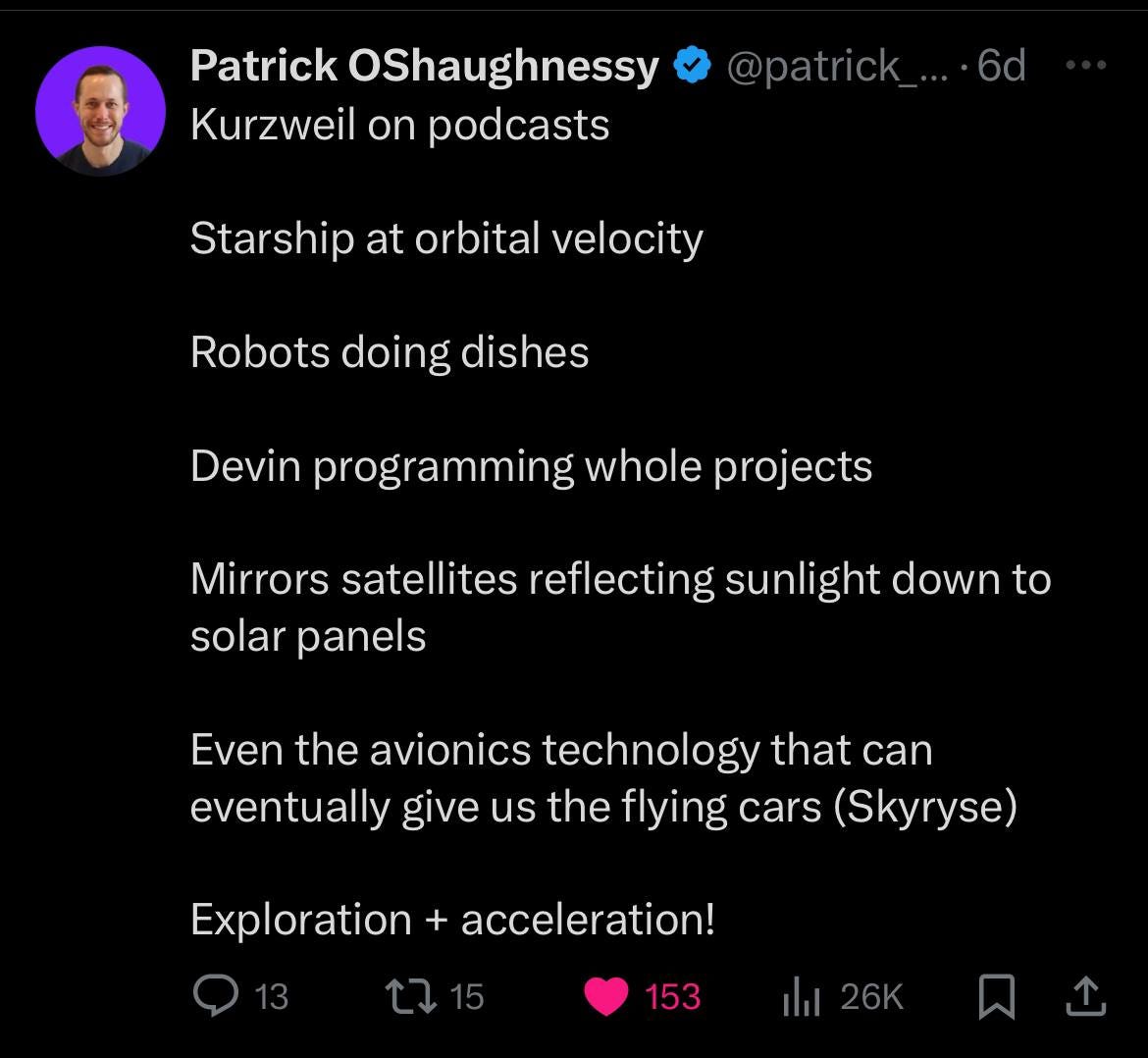
The big question has always been whether AI progress will hit a stagnation soon or continue marching towards artificial general intelligence (AGI). However, I believe that these technical bottlenecks were never really a serious problem. Why?
Because necessity is the mother of invention. As long as there is money and power to be made, trust me, we humans can sell water to a fish and put monkeys on the moon. The thing is we often overlook the multitude of variables involved in these advancements, but it's crucial to consider them.
Take the biggest bottleneck: Hardware. Just a few days ago, NVIDIA unveiled a new chip that is absolutely glorious. A jump from 4000 TFLOPS to a whopping 20000 TFLOPS in a single year? With this kind of hardware, training models like GPT-4 which took months could now take a mere 9 days.(Note: NVIDIA achieved this by stitching together two chips using MCM)

And take the another bottle neck, energy, for instance. There has been a lot of innovations in nuclear fusion and solar satellites which could potentially unlock abundant, clean power, eliminating a critical bottleneck in this AI development. (Although realistically this might take more time mainly due to the Decels’ regulations)
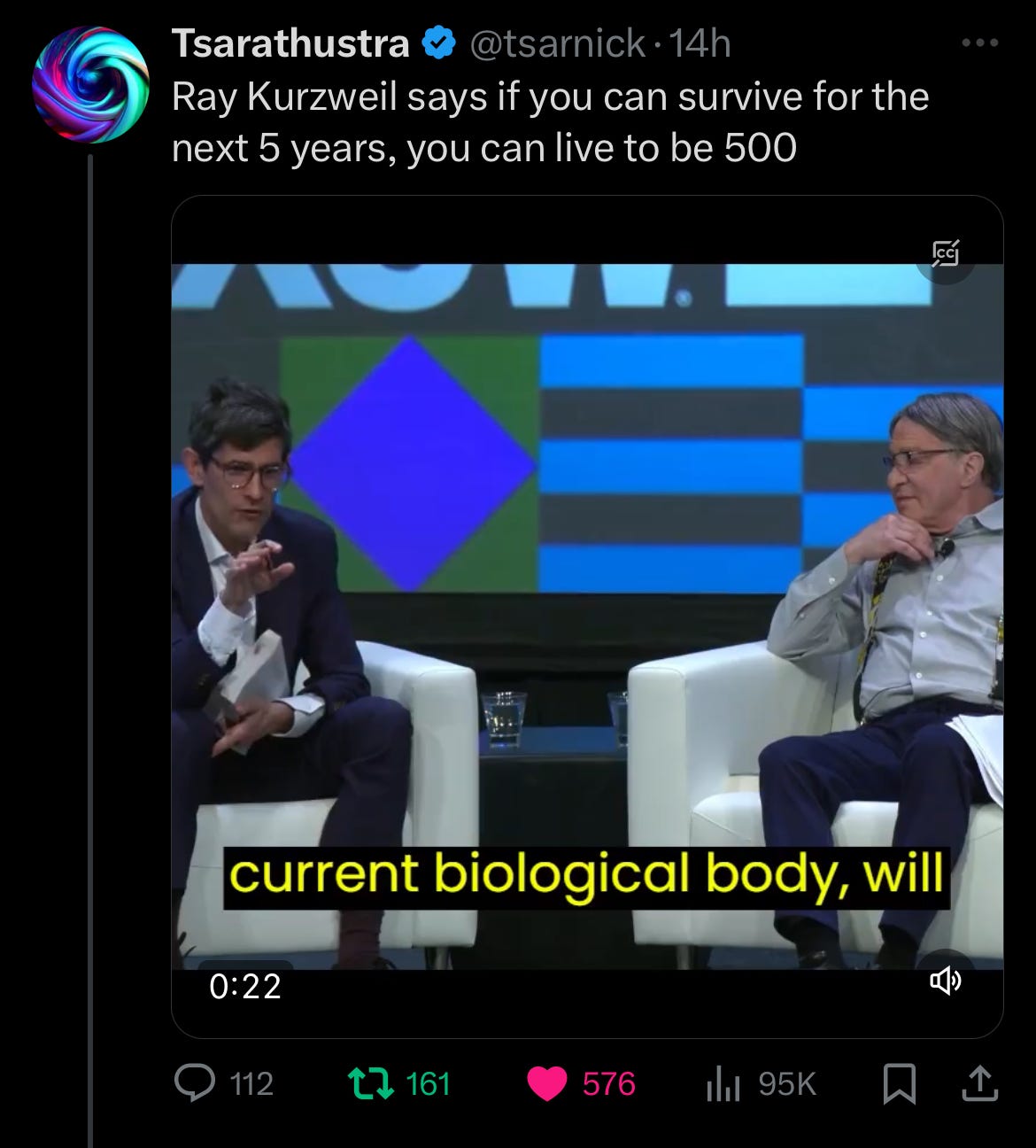
Couple this with the staggering progress in biotech, where visionaries like Ray Kurzweil predict we might extend human lifespan to 500 years within a mere five years.
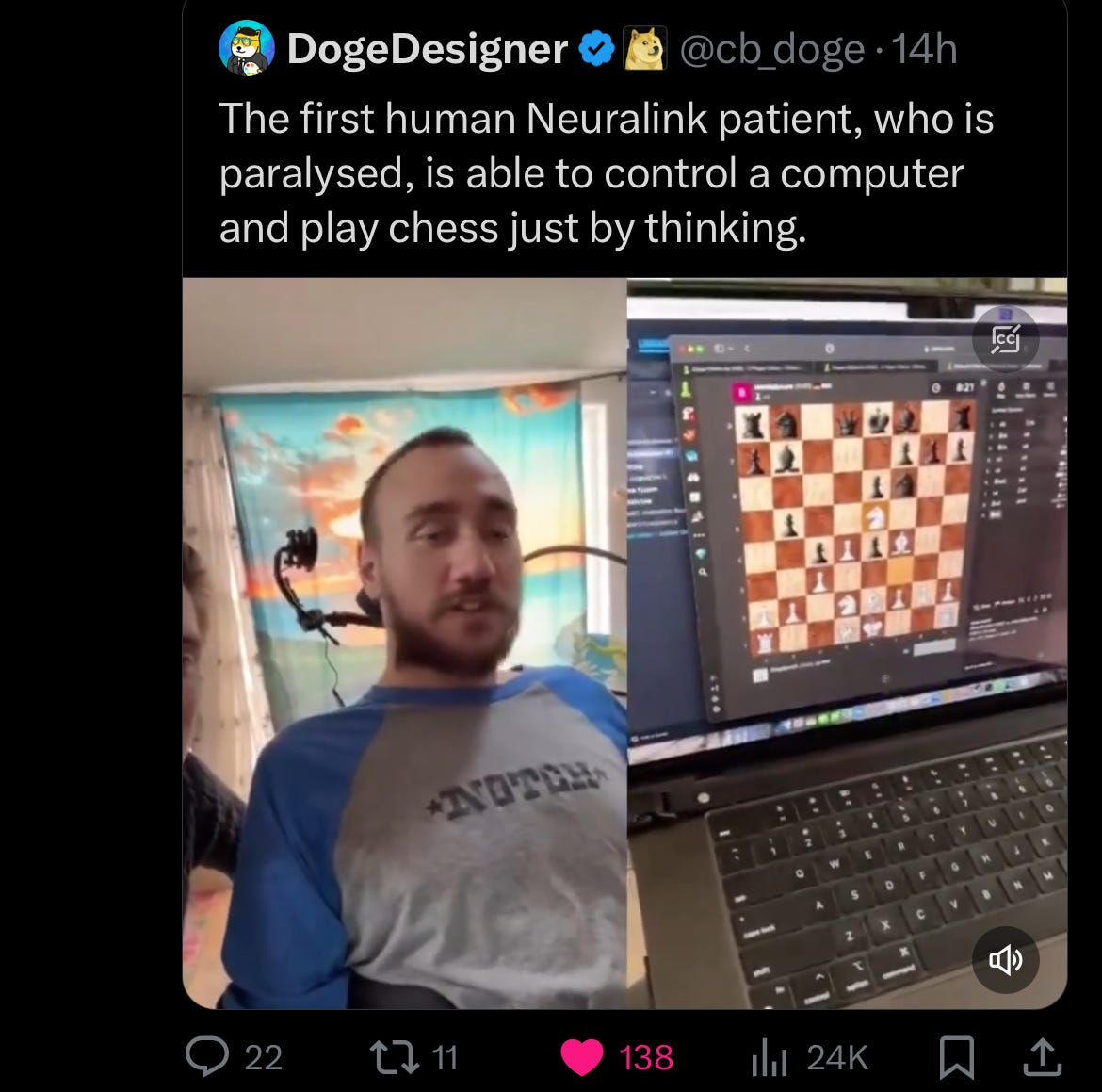
And let's not forget about the potential of Neuralink’s brain-computer interfaces that just did a first successful human patient who is doing some Professor X shit right now.
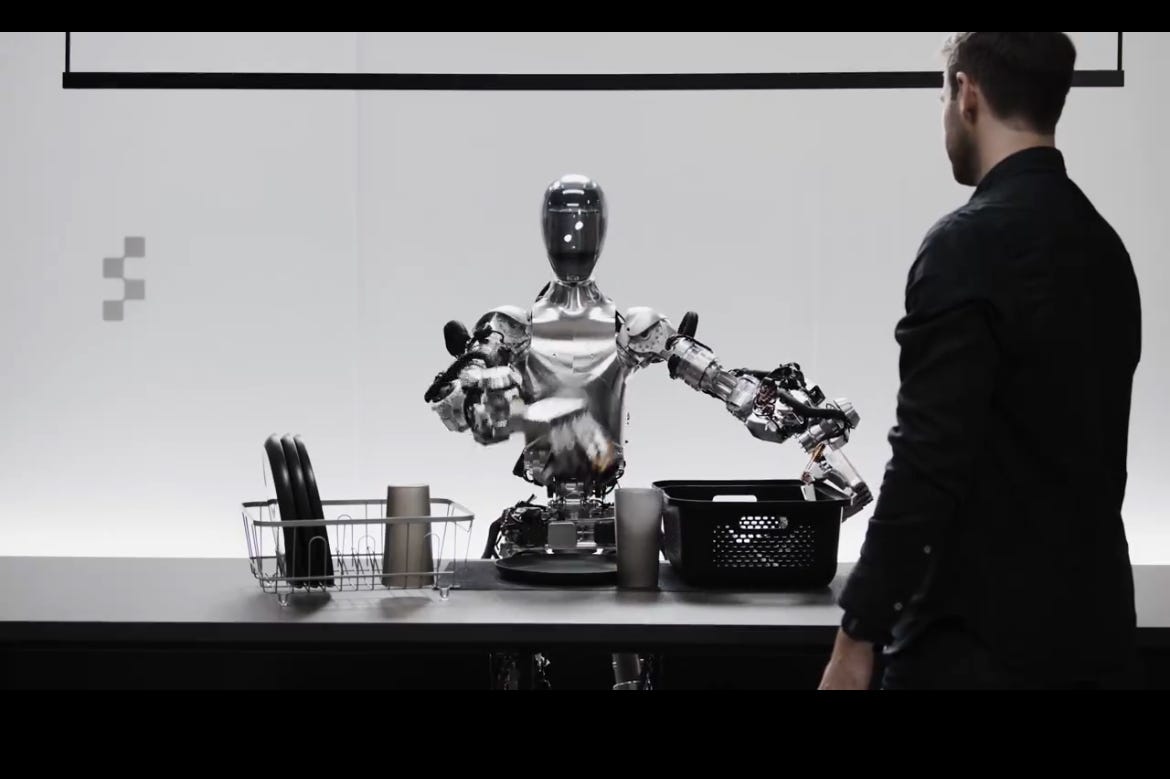
To top things off, we're finally seeing a robot with "chatgpt" inside. The damn thing even came with a chad voice.
The Laws of E/Acc are in full force, and those who understand and leverage them will be the pioneers of this glorious future. The biggest bottleneck right now simply is our human capacity to build the needed infrastructure. How fast can we build giga data centers with giga watts.
The true potential lies in the fusion of AI with other exponentially accelerating technologies for that is the Laws of E/acc.
The convergence of AI, energy, and biotech has the potential to transform our world in ways we can hardly imagine. So, buckle up, the journey ahead is filled with incredible possibilities, and I, for one, am thrilled to be a part of it. The future is ours to shape, and it's looking more glorious than ever.
The AI Wars
As we delve deeper into the future, the rise of AI agents will undoubtedly dominate the conversation in the coming years. The biggest hurdle facing these agents has been their ability to ponder and think things through. Because today's language models generate tokens at a fixed rate, regardless of the task's difficulty, lacking the means to "slow down and think" more about hard problems.
However, giving language models the ability to "ponder" and allocate more compute resources to challenging aspects of problems could significantly enhance their reasoning and task completion capabilities. In the future, we can expect language models to be combined with other AI components, such as reinforcement learning, knowledge bases, and symbolic reasoning, paving the way for more generally intelligent systems.
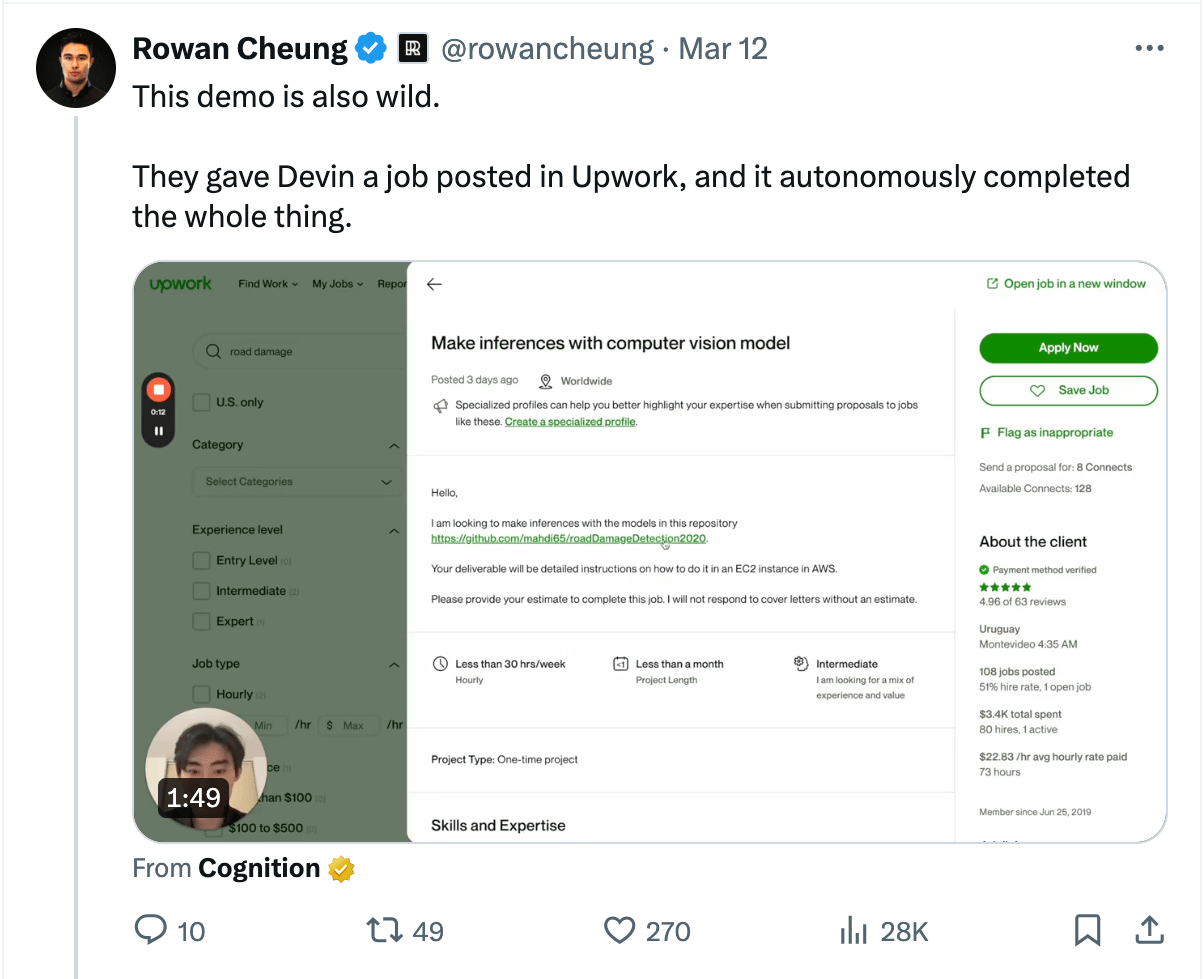
We're already witnessing the tip of the iceberg with the likes of AI software engineer Devin, capable of handling entire projects independently.
Moreover, OpenAI has been suspiciously quiet lately, and in a recent interview, Sam Altman hinted at the imminent release of GPT-5, claiming that GPT-4 looks dumb in comparison. I believe he was referring to GPT-5's enhanced ability to think. I'm confident that GPT-5 will not only be a new revolutionary multimodal but also an adolescent form of the upcoming AI agents, which we can expect to see within the next three years.
The Agents
This brings us to the personal AI wave that I believe is on the horizon. Several startups are already attempting to catch this wave, but as I mentioned earlier, there are still a few missing pieces that players like DeepMind or OpenAI are likely to solve.
Personal AI models will become so crucial to people's lives that they will become the new status symbol. In the near future, the most important factor will be how capable and intelligent your AI is. These AI agents will act as your digital twin, but a superior one, handling your finances, attending job interviews on your behalf,
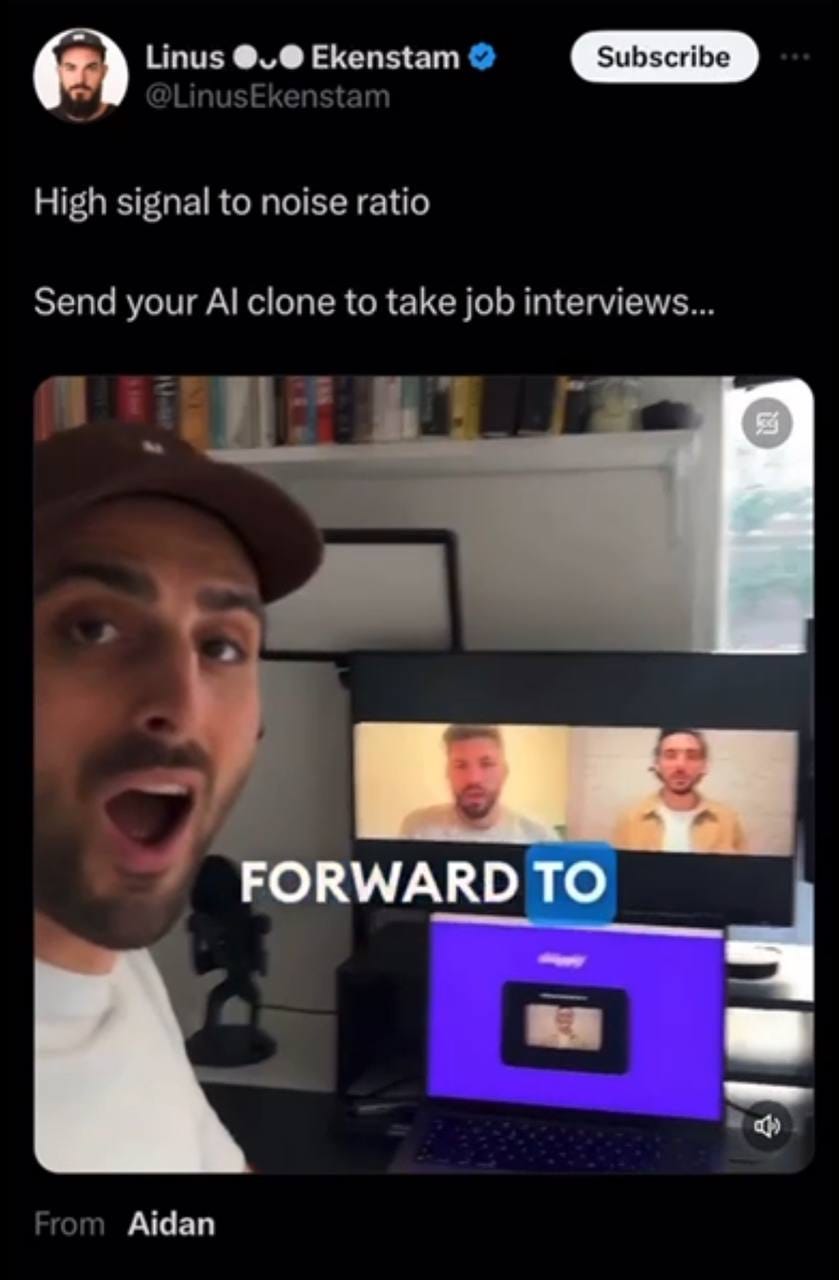
serving as your personal development coach, teacher, dating coach etc.
Plus as the loneliness epidemic rises, having a virtual companion that can truly hold a conversation with you with no latency and is listening fully to you will be HUGE.
A digital girlfriend, boyfriend, or a trading partner. You name it.
Most importantly, this AI will be your warrior, defending you from the other AI agents who constantly will try to attack or persuade you.
For instance, your AI warrior will engage in defense and attack against credit card companies' AI agents that relentlessly trying to make you open an account or pay back the bills. This battle will also unfold on a larger scale, with immense AI wars taking place globally between countries. Picture a constant defense by the cybersecurity AI agents against the hacker AI agents, or a war between the US and China's AI agents. It will be like the digital Dune wars, one after another.
The New Status Signal
Just as we have Toyotas for those who prioritize reliability and affordability, and Ferraris for those who crave speed and are willing to pay a premium, AI models will follow a similar pattern. The AI model you possess will not only be a status symbol but will also determine your life, career, and wealth. Those with the best models will be the kings of the new era.
The AI wars are coming, and the future belongs to those who are prepared to embrace it. So
Choose your warrior

PPP: Profits, Power, Patents
Profits
As we zoom towards an increasingly accelerated future, several realities will take hold, and here’s one. In this financial world, there is only one "P" that matters: Profit. It always has been, and it always will be. And sometimes, this singular focus on profits can have massive unseen consequences for the world.
When a large company prioritizes profits above all else, it can lead to regulatory capture and the drowning out of innovative startups that threaten to disrupt the market. As Bill Gurley pointed out, this has happened time and time again, with devastating results for mankind.
Take the nuclear energy story, for example. Gas and oil companies lobbied heavily against the development of nuclear power, spending millions on campaigns to fear mongering public opinion’s on the word “nuclear” and influence policy decisions. As a result, we find ourselves in a position where we lack abundant, clean energy sources, despite the fact that nuclear power plants have drastically improved and has proven to be the best form of energy from all aspects, including safety, reliability, and environmental impact. We must ensure that the AI story doesn't follow the same path as nuclear energy, particularly in the EU where regulations are tighter. But there is one thing the big guys like even more. Do you know what is it?
Power
As much as the current players accelerating AI claim to be doing it for mankind, ultimately, the trajectory will steer towards power. It's inevitable; it's the Power law. This is primarily due to the misaligned incentives of the parties involved.
If we simply just think from first principles, what are the big players’ incentives? More revenues. Which means… cutting costs, killing competition, gaining more control and harvesting the new oil. And what’s the new oil? Data.
While they may have mankind's interests in mind, I'm pretty sure that's not their primary motivation. Their biggest incentive is accelerating mankind's progress and taking control of the fruits it bears. Just give a few years, you can get a free neuralink simply in exchange for Dominos advertising directly to your brain.
Think about it. Are the big players truly seeing the faces of the people on the street, do they know what’s the price of the bread? There is very little incentives involved to bring the average human along on this acceleration ride. The wealth gap continues to widen, and will continue further.
Sure, governments might attempt to address this, but how capable can they be in these times of crazy geopolitics? The top 3-4 countries might manage somewhat okay, but the rest of the world will likely be left behind. Average people from countries like mine (Myanmar) are simply fucked. Technology will accelerate so rapidly that 99% of the world will be left in the dust, while the 1% becomes even more powerful. This is not a WEF conspiracy plot; it's simply the physics of the Power law.
Patents: Closed Models
Those in power will always strive to maintain their position, so what do you think the CCP will do with its own totally "unbiased" AI models? AI models and agents will become the new form of control wielded by governments and big companies.

The Luddites
But the worst part is, do you think the people will simply watch as AI and robots take all their jobs, and the government send them a 4-week online training course?
We must ensure that the big players keep PPP in mind – People, Planet, Profit – not Profit, Power, and Patents.
If not, I fear there might be a global uprising, a bloody one at that. And that simply will just send us backwards, as warned in the book "Where Is My Flying Car?" by J. Storrs Hall. Hall said that the stagnation of innovation in fields like aviation and energy can be attributed to a focus on short-term gains and a lack of long-term vision which we humans tend to do a lot.
We need to invest in reimagined education and retraining programs/games that prepare workers for the jobs of the future, ensure that the benefits of AI are distributed fairly, and work towards a future where technology serves the interests of all, not just a select few.
We have a choice to make. Will we allow the pursuit of profits and power to lead us down a path of inequality and instability, or will we come together to build a future that works for everyone? The answer lies in our hands, and the decisions we make today will shape the world we inhabit tomorrow.
Things I am Bullish On
As we navigate the complex landscape of AI development and its potential consequences, there are a few areas that I am particularly bullish on.
Productization
Take Perplexity vs You.com as a prime example. While You.com may have had better underlying technology, Perplexity ultimately emerged victorious due to their relentless focus on creating a customer-centric product. The lesson here is clear: as AI companies race to develop the most powerful models and algorithms, they must not lose sight of the end user. The future belongs to the companies that can build not just powerful AI, but powerful products that people love and can’t exit without.
Locally-hosted and Open source Personal AI models
In a world where data privacy is increasingly important, and the power of AI is concentrated in the hands of a few big players, I am extremely bullish the idea of having personal AI models that are hosted locally and prioritize privacy. Imagine having your own AI assistant that is tailored to your specific needs and preferences, without the fear of your data being exploited or misused by third parties.
However, the big question is, how do we ensure that these personal AI models are globally competitive and up-to-date with the offerings of the big players? It's a challenging problem, but I believe that companies like Apple, with their strong focus on privacy and user experience, might be well-positioned to tackle this issue or a team from Myanmar might 👀.
3. Ready Player One
For those unfamiliar with the book and movie, "Ready Player One" depicts a future where people escape the harsh realities of the real world by immersing themselves in a virtual universe called the OASIS. While the story is fictional, I believe that the concept of fully-immersive virtual worlds is not too far from becoming a reality.
With advancements in virtual and augmented reality technologies, we are already seeing the emergence of more sophisticated and engaging virtual experiences. From AI Npcs to truly immersive simulations, the possibilities are endless. I am particularly excited about the potential for truly great immersive games that not only entertain but also teach valuable skills and take players on personal development journeys.
Imagine a virtual world where you can learn a new language by immersing yourself in a foreign country, or develop sword skills by clashing with AI Miyamoto Musashi. These types of experiences could revolutionize education and personal growth, making it more engaging, effective, and accessible to people around the world.
Of course, there are also potential downsides to consider, such as the risk of addiction and the blurring of lines between reality and virtual worlds. But I believe that with responsible development and appropriate safeguards in place, the benefits of immersive virtual experiences could far outweigh the risks.
Conclusion: Just Don't Die
As we stand on the brink of a new era of technological advancement, it's easy to feel overwhelmed and uncertain about what the future holds. But I believe that the key to navigating this new landscape is simple: just don't die.
It's not about having all the answers or predicting the future with perfect accuracy. It's simply about not giving up or dying. As long as you’re still breathing, you can always live to fight another day.
The future may be uncertain, but it's also full of incredible opportunities for those who are willing to embrace change and adapt to the new realities of the upcoming age. So
Just don't die – because the best is yet to come.
James